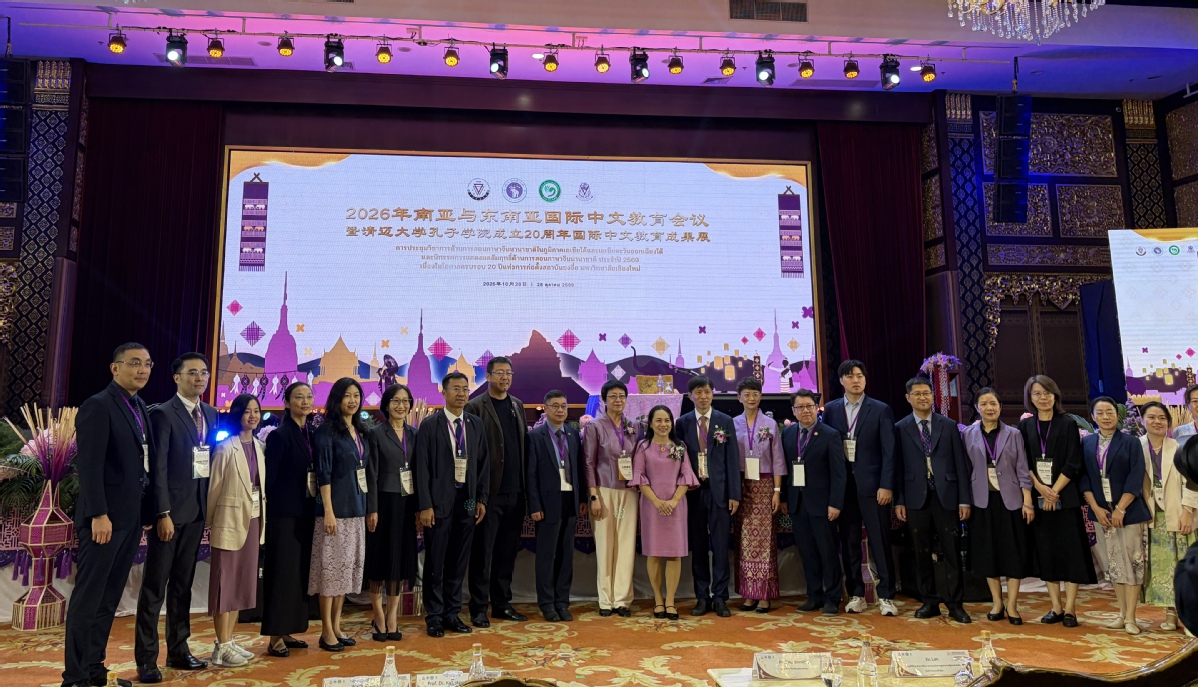
 Guests gather for photo session during the 2026 International Conference on Chinese Language Education in South and Southeast Asia held on Oct 28 in Chiang Mai, Thailand. [Photo by Yang Wanli/chinadaily.com.cn]
Chinese language education in South and Southeast Asia should deepen its links with local industries, strengthen the development of local teachers and harness artificial intelligence to improve teaching quality, education officials and scholars said on Wednesday.
The recommendations were outlined at the 2026 International Conference on Chinese Language Education in South and Southeast Asia, held in Chiang Mai, Thailand, alongside an exhibition marking the 20th anniversary of the Confucius Institute at Chiang Mai University.
During the event, the Confucius Institute at Chiang Mai University launched the 2026 Initiative for Sustainable Development of International Chinese Language Education in South and Southeast Asia. The initiative was jointly released with 31 Confucius Institutes and educational institutions from six South and Southeast Asian countries.
Lian Chen, director of the institute, said artificial intelligence was reshaping the form and boundaries of education, while Chinese language education faced challenges including changing learner demands, uneven resource distribution, a shortage of locally trained teachers and a widening digital divide.
Chinese education, she said, needed to move beyond language instruction to support livelihoods, mutual learning among civilizations and the development of a community with a shared future.
The initiative calls for a shift "from the classroom to industry, from language to capabilities, and from individual projects to a sustainable ecosystem," Lian said, adding that a "Chinese plus industry" model can connect language learning with practical skills and employment opportunities, in particular sectors including new energy, cross-border e-commerce, smart agriculture and the digital economy.
Hu Jinming, president of Yunnan Normal University, described the institute as a notable achievement in strengthening people-to-people ties and promoting mutual understanding between China and Thailand during his opening speech.
As the Chinese university providing targeted support to the Confucius Institute at Chiang Mai University, Yunnan Normal University was set to lead the establishment of the South and Southeast Asian International Chinese Language Education Alliance last year, according to Hu.
"Our university has so far enrolled more than 20,000 international students from 138 countries, with students from South and Southeast Asia accounting for 80 percent of the total," he said.
"We all continue to support the institution and train Chinese language teachers and professionals combining Chinese proficiency with vocational skills."
Beyond teaching and workforce development, the initiative also calls for closer alignment between Chinese language proficiency and professional, digital and intercultural competencies.
It proposes exploring diversified assessment systems that better reflect the practical value of Chinese language education in further study, employment, industrial cooperation and the movement of talent across borders.
Xu Lan, education counselor at the Chinese embassy in Thailand, said closer cooperation between China and Thailand and other countries in Southeast Asia in terms of education could contribute to a more stable, prosperous and sustainable China-Thailand community with a shared future.
She also urged closer cooperation between educational institutions and businesses to ensure that Chinese language courses reflected actual workplace requirements.
In sectors such as new energy vehicles, cross-border e-commerce, high-speed rail technology, healthcare and elderly care, she said companies could help develop course standards and practical training systems, allowing students to apply their language skills in real working environments.
"Artificial intelligence could further support this transformation, particularly by improving pronunciation instruction, providing personalized learning assistance and expanding access to educational resources," Xu said.
If you have any problems with this article, please contact us at app@chinadaily.com.cn and we'll immediately get back to you.